





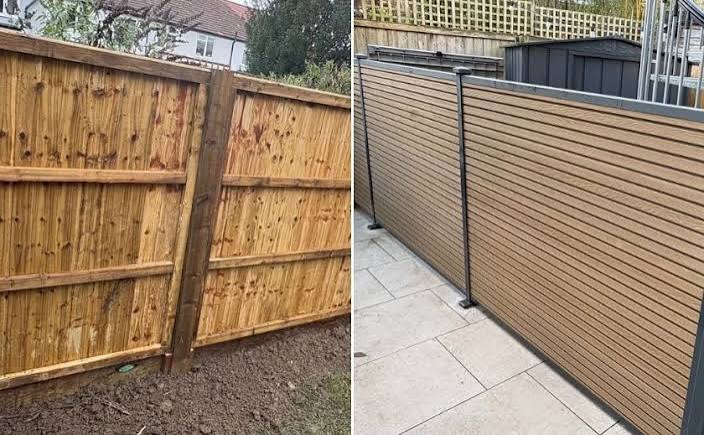
Composite fencing gets promoted as the answer to almost every irritation associated with timber. No painting. No staining. No rot. Less maintenance. A consistent finish. There is plenty to like about it, and I’ve seen good composite fencing make a lot of sense in the right garden. But there is one problem it cannot solve.
Bad installation.
You can spend considerably more on the material and still end up with a poor fence if the structure supporting it hasn’t been thought through properly.
That sounds obvious, but fencing is one of those trades where most of the important work eventually disappears underground. Once everything is finished, the homeowner sees straight posts, clean panels and a tidy garden.
They don’t see how deep the holes are.
They don’t know what the ground was like at the bottom.
They can’t see whether somebody dealt properly with an awkward slope or simply forced everything into position.
And they certainly can’t see how the installation will behave after several Yorkshire winters.
Composite changes the material above ground. It doesn’t change the basic rules of building a fence.
Composite does solve genuine timber problems
There is no point pretending composite has become popular purely because it looks modern.
It addresses some real maintenance issues.
Traditional timber fencing is exposed to rain, sunlight and changing temperatures throughout its life. Even good treated timber changes in appearance. It can shrink, swell, split and weather. Depending on the timber and treatment, homeowners may also choose to stain or coat it periodically.
Some people enjoy maintaining timber.
Plenty don’t.
Composite appeals particularly to homeowners who want a relatively consistent appearance without periodically spending a weekend with a brush and a tin of treatment.
It also avoids one of the biggest concerns associated with timber components close to the ground – decay.
That can make it particularly attractive in gardens where owners have already replaced rotten timber fencing once and don’t particularly fancy doing it again.
But “low maintenance” and “no maintenance” aren’t the same thing.
Composite still gets dirty. Algae and surface grime can develop, particularly in shaded or damp areas. Vegetation still needs managing. Gates still have hinges and latches. Posts and supporting components still need checking.
The fence hasn’t become furniture you can install and forget about for the next few decades.
The posts still have to resist the wind
This is the bit that gets lost in discussions about fencing materials.
A fence is a structure.
Wind pushes against it.
That force travels through the panels or boards and into whatever is supporting them. Ultimately, the installation has to transfer that load into the ground.
Composite doesn’t repeal physics.
In fact, solid fencing deserves particularly careful thought because wind cannot easily pass through it.
Imagine holding a large solid board upright on a windy day. You would quickly feel the force acting against it. Increase that surface area across several metres of fencing and those forces become substantial.
The posts are what resist them.
So when somebody spends money upgrading the visible part of a fence but cuts corners on the foundations, I struggle to see the logic.
I’d rather install a modest fence on properly specified posts than an expensive one on inadequate foundations.
Every time.
Ground conditions don’t care what the panel cost
Around Barnsley and elsewhere in South Yorkshire, ground conditions can vary significantly from one property to another.
Some gardens are straightforward.
Others aren’t.
You can encounter heavy ground, clay, rubble, old concrete, roots, drainage problems and made-up ground where previous landscaping or development has changed what sits beneath the surface.
Newer developments can bring their own challenges because gardens may contain disturbed or filled ground rather than soil that has sat untouched for decades.
None of this necessarily prevents a composite installation.
It just means the person digging the holes needs to pay attention.
Post depth isn’t something that should be decided by habit alone. Fence height, exposure, ground condition, post system and the manufacturer’s requirements all matter.
If you hit difficult ground early, the answer isn’t automatically to decide the hole is deep enough.
I’ve seen that approach before.
The fence generally looks excellent on the afternoon it is finished.
The problems arrive later.
Straight on installation day proves very little
Getting a fence straight isn’t particularly impressive.
Keeping it straight is the harder part.
String lines, levels and careful setting can make an installation look excellent when the concrete is fresh. What matters is whether the structure remains stable once the ground becomes saturated, dries again, freezes, moves and takes repeated wind loading.
This is one reason photographs of newly installed fencing only tell part of the story.
I’d be far more interested in seeing the same installation five years later.
If posts begin to move, composite boards won’t somehow pull them upright. If the structure goes out of alignment, the clean geometric appearance that attracts people to composite fencing can actually make that movement more noticeable.
Long straight lines are unforgiving.
One post slightly out of position can stand out immediately.
Low maintenance shouldn’t become an excuse for low attention
One selling point of composite is that you don’t have to treat it in the same way as traditional timber.
Fair enough.
But I wouldn’t translate that into never looking at the fence again.
Once or twice a year, walk around it.
Check that posts remain stable. Look for movement. Make sure vegetation isn’t putting unnecessary pressure against sections. Clean off surface contamination where required and follow the maintenance guidance for the particular system installed.
Pay attention to gates too.
A gate that suddenly stops lining up can be an early indication that something has moved.
People sometimes start adjusting hinges and latches when the actual problem is the supporting post.
If you keep altering the gate to compensate for movement elsewhere, you’re treating the messenger rather than the problem.
Composite isn’t automatically the right answer
This is where I’d push back against some of the marketing around the material.
There are gardens where I would happily recommend it.
There are others where good timber fencing makes perfect sense.
Composite tends to suit homeowners who value predictable appearance and reduced ongoing maintenance. It can work extremely well with contemporary landscaping and modern properties, and it can be useful where somebody simply doesn’t want the upkeep associated with timber.
But timber has advantages too.
It can be repaired relatively easily. Individual boards and rails can often be replaced. It suits a huge range of properties. Good pressure-treated timber, properly installed and looked after, can give excellent service.
There is also the question of budget.
The relevant comparison isn’t simply the initial composite fencing cost against the cheapest timber alternative.
You need to compare sensible specifications.
What supporting system is being used?
What preparation is included?
What is the expected maintenance?
How repairable is the system?
What warranty applies to the materials?
What happens if one component gets damaged?
A low headline price can become much less attractive once you discover what has been omitted.
The same applies to timber.
Sloping gardens expose lazy installation
Flat, rectangular gardens make fencing relatively straightforward.
Real gardens have other ideas.
They slope. They change level. Boundaries aren’t always straight. Existing walls get in the way. Tree roots appear exactly where a post needs to go. Sheds leave almost no working space. Old concrete seems to have been poured in places where no rational person would ever want concrete.
This is normal fencing work.
Composite systems can require careful planning on changing levels because the regular appearance makes poor stepping particularly obvious.
You don’t want to reach the final few metres and suddenly discover the levels don’t work.
Measure first.
Work out the changes.
Decide how the fence will step or follow the site.
Then start installing.
Trying to solve every problem as you encounter it usually produces compromises.
Don’t ignore the manufacturer’s system
Composite fencing isn’t one universal product.
Different manufacturers use different board profiles, post systems, channels, reinforcement methods, spacing requirements and installation details.
That matters.
If a manufacturer specifies a particular method, there is normally a reason.
Mixing components, ignoring required tolerances or improvising fixings can undermine the performance of the finished fence and potentially affect warranties.
This is another reason I wouldn’t buy purely on appearance.
Two composite systems can look broadly similar in a photograph while being quite different in construction.
Ask what is actually being installed.
A competent fencing contractor should be able to explain the supporting system rather than simply showing you a colour sample.
The boring questions are often the useful ones.
Expansion needs to be understood, not guessed at
Composite materials can expand and contract as temperatures change.
How much depends on the product and how it is manufactured.
This doesn’t make composite problematic. It means it needs to be installed according to the requirements of the system.
Clearances and fixing methods exist for a reason.
If boards are fitted without allowing for the movement specified by the manufacturer, changes in temperature can cause problems later.
Again, this is something you won’t necessarily notice when the fence is first completed.
A lot of poor workmanship works perfectly on day one.
That’s what makes it poor workmanship rather than obviously unfinished work.
Repairs deserve consideration before installation
One question I think homeowners should ask more often is: what happens if somebody damages it?
A football isn’t much of a concern.
A vehicle reversing into a driveway boundary might be.
So might a falling branch or accidental impact.
With traditional closeboard fencing, individual timber components can often be replaced relatively easily.
With proprietary composite systems, repairability depends on how that particular system is assembled and whether matching components remain available.
That shouldn’t put you off.
It should simply form part of the decision.
If you’re investing in a fencing system expected to remain in place for many years, knowing how individual components can be replaced is sensible.
Pay for the structure, not just the finish
I understand why composite fencing sells.
It looks clean. It can be extremely smart. The maintenance proposition appeals to busy households, and many people simply prefer its appearance.
None of that is hype.
The mistake is assuming that because the boards won’t rot like timber, the whole fence has somehow become immune to the problems that affect every boundary structure.
It hasn’t.
Posts can move.
Footings can fail.
Ground can shift.
Gates can drop.
Fixings can be installed badly.
Wind can exploit weaknesses.
An expensive material doesn’t compensate for any of those things.
If I were spending the extra money on composite, I’d spend less time worrying about which shade looked best on a sample and more time asking what was going into the ground.
You’ll spend years looking at the boards.
But it’s the work you can’t see that will decide whether they stay where they’re supposed to.